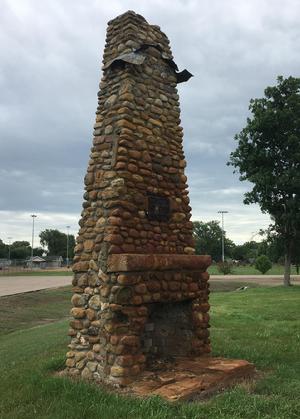
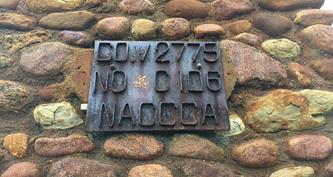
This chimney was the last reminder of the recreation hall at Civilian Conservation Corps (CCC) Camp V2775, located at the former fairgrounds—now a baseball and softball complex—in southwest Mandan. The camp was staffed by World War I veterans, hence the “V” designation. Only three of the more than 250 CCC camps in the nation were reserved for veterans. A typical CCC company consisted of about 250 men ages 17 to 23. After another 45 men joined the Mandan camp through an October 1937 consolidation with the Fargo camp, the Mandan location became the largest CCC camp in North Dakota.
During their off-hours, CCC workers played cards, billiards, and table tennis or bought snacks at the recreation hall's canteen. A baseball field stood just outside, where one of Mandan's softball diamonds is today. At the National Association of CCC Alumni's annual reunion on July 15, 1989, the group placed a plaque made by member Merlin Dahl in the chimney to commemorate its significance.
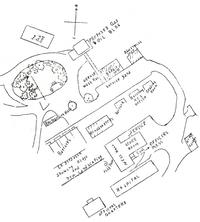
The Civilian Conservation Corps operated from April 1933 through June 1942. The federal program sought to relieve widespread unemployment and hardship during the Great Depression by restoring natural resources and building public works such as parks and municipal utilities.
Fort Abraham Lincoln, six miles south of present-day Mandan, was established in 1872 to protect area settlers and construction of the Northern Pacific Railroad. It was abandoned in 1891 after fulfilling its mission. In 1907, President Theodore Roosevelt deeded the former fort's grounds to the State of North Dakota.
Park development began July 4, 1934, under the direction of the National Park Service in cooperation with the State Historical Society of North Dakota. Its primary aim was to preserve the area's history, including the Mandan Slant Indian Village and the ruins of Fort Abraham Lincoln's infantry and cavalry posts.
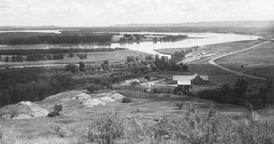
Major preservation projects included rebuilding the blockhouses and palisades at the infantry post; marking foundations and labeling building sites at both posts; rebuilding five Mandan earth lodges at the Slant Village site; and constructing a native-stone museum for historical displays. The reconstructed fort and state park buildings were dedicated July 17, 1938.
After completing their work at the state park, crews were redeployed to improve the City of Mandan's fairgrounds near their camp.
About 33,000 North Dakota men served in the CCC. Nationwide, the Depression-era program employed 3 million young men over nine years. Its workers built, installed, or restored 46,845 bridges, 800 state parks, 4,622 fish-rearing ponds, 5,000 miles of water-supply lines, and 3,462 beaches. They also relocated 45 million trees and shrubs and planted 3 billion trees.
The Mandan Park District demolished the chimney in 2024 as part of the baseball and softball complex expansion project.
The Society thanks Arley Olson for sharing his research and other information for this article.