In 1909, W. A. Lanterman, L. N. Cary, C. L. Timmerman, E. H. Hugh, and T. A. Cummins led a weeklong fundraising drive to establish a modern hospital in 29-year-old Mandan. The successful campaign created a stock company capitalized at $50,000 (about $1,792,000 in 2025 dollars), with 100 stockholders, including 50 area farmers.
Stockholders announced in August 1909 that the hospital would be built in the Heartview Addition. The meeting was held in the Business Men's Club rooms at the InterOcean Hotel. Other locations considered were in the First Northern Pacific Addition and the Helmsworth and McLean's Addition.
The Mandan Pioneer praised the south-facing hillside location on the western edge of town as a suitable site for the proposed $30,000 (about $1,075,000 in 2025 dollars) public building. In October 1909, the construction contract was awarded to C. E. Wierschke of Glenwood, Wisconsin, for $22,400 (about $803,000 in 2025 dollars). Mandan's first formal hospital, a three-story brick building, was completed in 1910 and opened June 11.
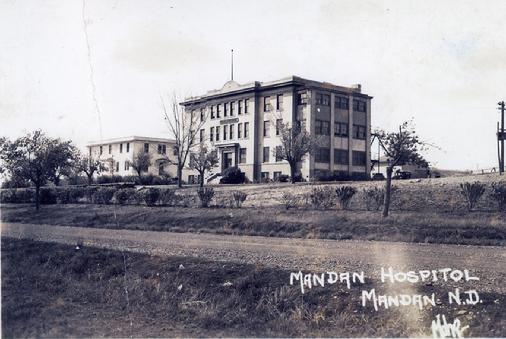
The hospital contained 12 private rooms, ten double rooms, a large ward, and apartments for attendants and employees. Mandan's eight practicing physicians received initial privileges, and seven registered nurses staffed the facility. The third floor was initially expected to house a three-year nursing school.
Area Methodist churches assumed operation in 1918. The institution, renamed Deaconess Hospital, served patients of all faiths.
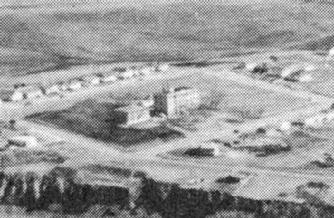
A new annex and nurses' home were dedicated in May 1936. The $12,500 (about $290,000 in 2025 dollars) expansion accommodated Mandan's growing population and helped ensure adequate nursing staff. Control of the institution and building later passed to the City of Mandan, which operated it as the nonprofit Mandan Hospital.
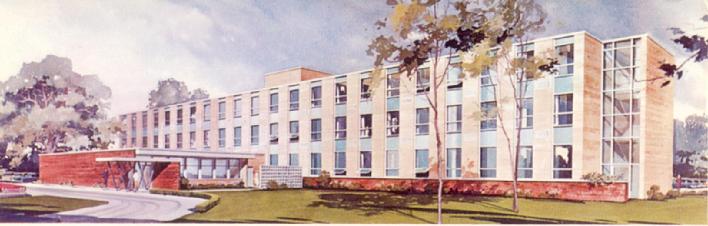
In June 1961, Mandan voters approved a $400,000 (about $4,310,000 in 2025 dollars) bond issue for a new hospital with 91.8 percent voting yes. Initially planned as a 56-bed, $950,000 (about $10,235,000 in 2025 dollars) facility, it opened September 9, 1963, with 63 beds. A five-physician clinic was added in 1964, and an interchange connected the site with the newly constructed four-lane Interstate 94 in 1965.
Heartview Alcoholism Treatment Clinic purchased the former hospital and adjacent nurses' home in November 1963 and converted the complex into a 40-bed facility offering inpatient and outpatient care. As the only institution of its kind between Minneapolis and Seattle, Heartview expanded both its services and capacity. A 1978 addition increased inpatient capacity to 76 beds but required demolition of the original hospital. A 16-bed adolescent unit completed in 1986 brought the complex to a peak of 91 inpatient beds.
Heartview served patients from across the United States and Canada. Financial difficulties eventually forced the Heartview Foundation to downsize, and the program moved to Bismarck in 1996. HIT Inc. purchased the building and continued expanding services for people with physical or developmental disabilities. HIT moved to a larger northern Mandan facility in 2012. The former hospital property was subsequently owned by North Dakota Teen Challenge.