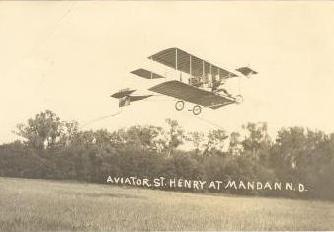
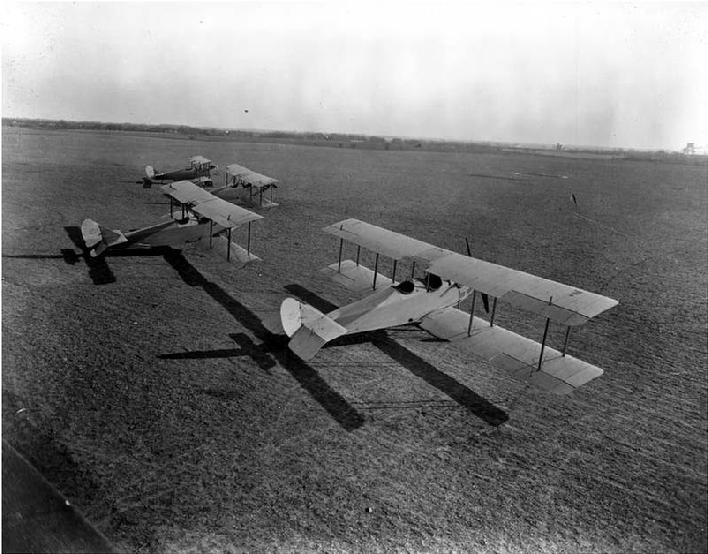
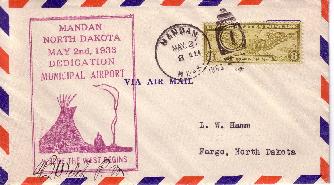
Mandan's first municipal airport was Eielson Field, south of the eastern end of the area now commonly called the Strip. Although the airport was formally dedicated May 2, 1933, construction continued that July as workers cleared and stacked timber from the site. The City reserved the wood as home-heating fuel for the following winter in place of coal.
A February 6, 1934, letter from Governor William Langer to Washington attorney Seth W. Richardson provides a more detailed description of the airport. Langer placed Ben Eielson Field three miles west of the Bismarck post office and 3.1 miles east of the Mandan post office, along the concrete surface of U.S. Highway 10. He described a square, 160-acre tract with four runways ranging from 3,000 to 3,600 feet long. The field, he wrote, was entirely level, with sandy loam soil over a gravel subsoil, and could be maintained at reasonable expense.[1]
The letter involves an attempt to establish a joint airport for Bismarck and Mandan at Eielson Field. Mandan had proposed the arrangement, and Bismarck had rejected it. Langer's appeal in the letter urges approval and financial support for Mandan's proposal. He argued that Eielson Field's central location and capacity could serve both cities, while consolidating their airports would avoid duplicate equipment and maintenance costs.[2]
The joint airport effort ultimately did not succeed.
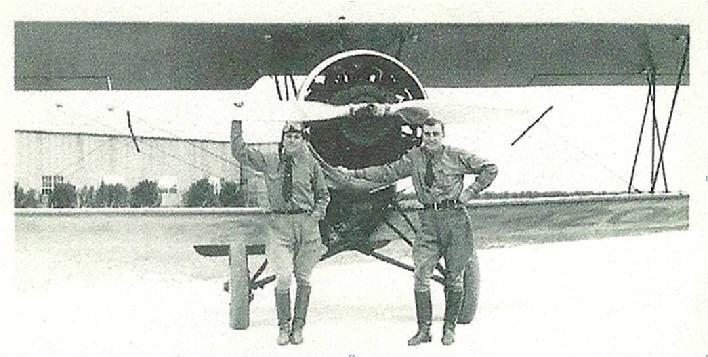
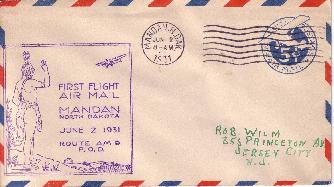
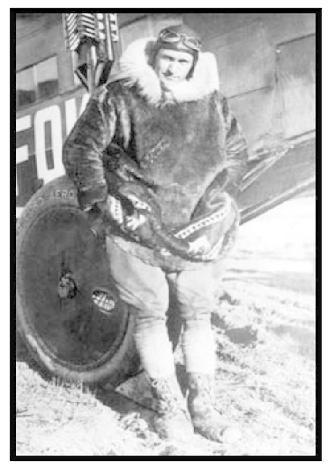
The field was named for Hatton, North Dakota, native Carl Ben Eielson. In April 1928, Eielson and Hubert Wilkins flew a Lockheed Vega from Point Barrow, Alaska, to Spitsbergen, Norway, becoming the first people to cross the North Pole by air. Expected to last about 20 hours, the flight took six days after the aviators encountered a severe winter storm.
Eielson enlisted in the U.S. Air Corps in 1917 and later served in the aviation section of the U.S. Signal Corps during World War I. After the war, he briefly returned to North Dakota. He was recruited as an Alaska airmail pilot in 1921 and went on to make Arctic aviation history. Eielson and his mechanic died in December 1929 while attempting to rescue 15 people aboard the cargo ship Nanuk, which was trapped in ice off Siberia's North Cape.
Although Mandan's present airport no longer bears Eielson's name, the U.S. Air Force operates Eielson Air Force Base 25 miles southeast of Fairbanks, Alaska. Established in 1939 as a cold-weather aircraft-testing station, the base became home to the 354th Fighter Wing. A World War II Liberty ship and numerous schools in Alaska and North Dakota were also named for Carl Benjamin Eielson.
Further reading
For more about Eielson's life, see North Dakota's Polar Pilot by Paulette Bullinger and Kevin Kremer.
Sources
- William Langer. Letter from Governor Langer to Seth Richardson Regarding Bismarck Airport, 1934. February 6, 1934. William Langer Papers, item 46. Elwyn B. Robinson Department of Special Collections, University of North Dakota, UND Scholarly Commons. Letter p. 1 (PDF p. 2). View document. Accessed .
- William Langer. Letter from Governor Langer to Seth Richardson Regarding Bismarck Airport, 1934. February 6, 1934. William Langer Papers, item 46. Elwyn B. Robinson Department of Special Collections, University of North Dakota, UND Scholarly Commons. Letter pp. 1–2 (PDF pp. 2–3). View document. Accessed .