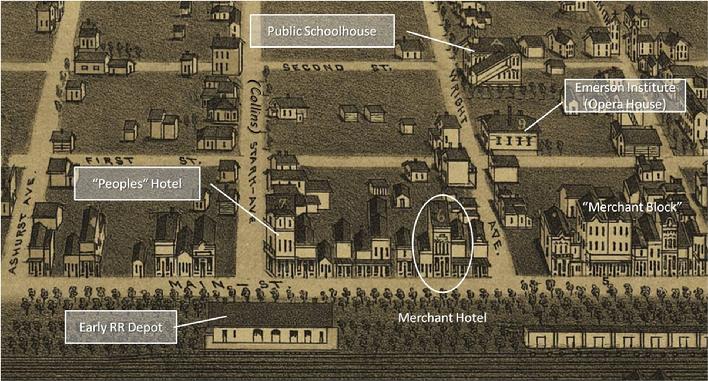
The Emerson Institute was Mandan's second public building, following the log-cabin county courthouse. It originated with “a debating society which was conducted for the mental recreation and improvement of the first settlers of the town.” The group approached the Northern Pacific Railway, which offered three lots for “reasonable consideration” on the condition that they be used for a lecture and education center. The institute was named for Ralph Waldo Emerson, an influential 19th-century writer and thinker who died in April 1882.
Frank Mead, Michael Lang, B. L. Winston, and P. O. Chilstrom funded the initial land purchase. H. R. Lyon, Frank Farnsworth, James Bellows, Carpenter & Cary, George Bingenheimer, and E. F. Doran also helped establish the venue. Community donations raised $3,000 (about $100,000 in 2025 dollars) to construct the original 36-by-80-foot wooden building, completed in fall 1882, only three years after Mandan's founding.
The building contained “all the modern improvements, tastefully painted and finished,” with a ticket office on the right and a waiting room and women's dressing room on the opposite side. The February 18, 1882, Mandan Weekly Pioneer described the theater's place in the community: “The theater, though on rare occasions in the use of traveling professionals, is almost entirely in the hands of the Mandan dramatic club, whose members are the very cream of this city. They give frequent and most enjoyable amateur performances. The existance of such a society in so young a town as this is especially significant, as it speaks volumes as to the prosperity of the inhabitants who are so favored that they may safely unbend their minds, relax in the rigid pursuance of their avocation and let pleasure attend upon the cares of business, which makes the third feather in the cap of all Mandanites.”
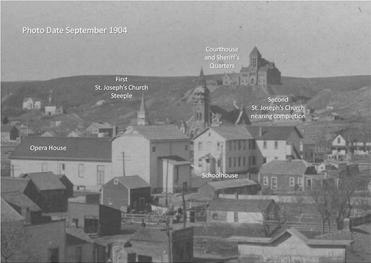
The 1884 Mandan Pioneer Immigrant Edition highlighted the venue as evidence of the cultural and social life of a city of 2,500, described as only three years old. The original stage at the east end was described as “large enough for all ordinary purposes,” with scenery, footlights, and the accessories needed for a “first class proscenium.” Tuttle and Wilson were the original managers; H. R. Lyon held the position by 1884.
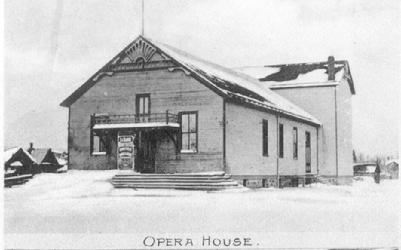
National theatrical guides listed the original stage as 30 by 40 feet, with a proscenium 20 feet wide and 12 feet high and seating for 300. Chairs could be rented through Bingenheimer & Taylor's Drug Store, and a piano and scenery were available on-site. The building was featured in a 1906 souvenir book promoting Mandan and its economic opportunities.
The institute hosted Fourth of July and New Year's Eve dances, live performances ranging from serious drama to vaudeville, basketball games, graduation ceremonies, and public meetings. An addition completed on the east side in spring 1893 enlarged the stage and backstage areas and raised seating capacity to 500. The expanded venue was renamed the Opera House.
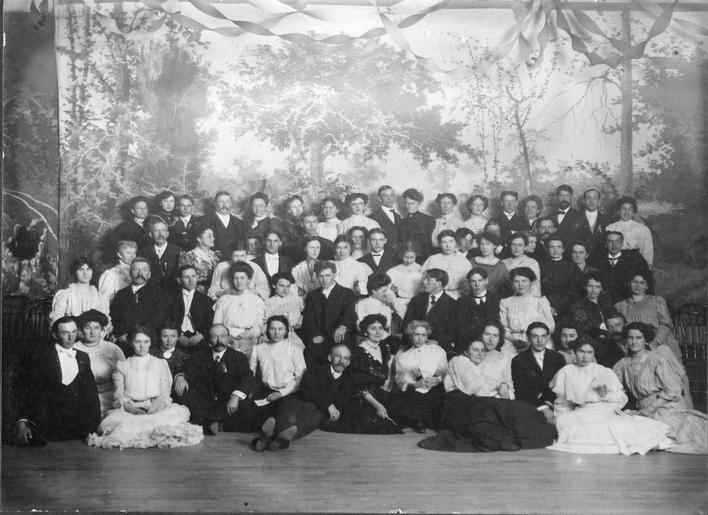
Dances were frequent fundraisers in the early 1900s. The Ladies of the Library board held an annual New Year's Eve dance at the Opera House, often accompanied by the seven-piece Lochner's Orchestra. Supper was served onstage at 11 p.m. Dorothy Fiske served as board president.
The Opera House accommodated a wide range of social and cultural events from the 1880s through the 1920s, including live professional wrestling and boxing. The Mandan Elks held their first meetings there in 1911. High school athletics moved to the school gymnasium after it opened in 1919. The Opera House became less popular for live entertainment after the Palace Theatre opened in December 1916 on Third Avenue Northwest, between the Lewis and Clark Hotel and the Hotel Donaldson.
The building also served as Mandan's first North Dakota National Guard armory. The construction of the World War Memorial Building in 1934 diminished the need for the Opera House. The memorial building also served as an armory and now houses Mandan City Hall. The Opera House was demolished and its lot sold.