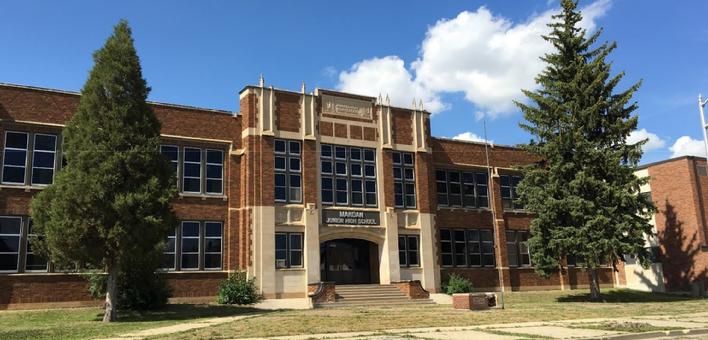
Work began in 1899 when the Mandan Board of Education sought a suitable location and asked voters to invest $15,000 (about $581,000 in 2025 dollars) in a new Central School. The building would house junior and senior high school students and provide a larger grade school for the western part of the city. The selected five-acre site lay along the southern foot of the bluff at the city's northern edge. Mandan was expected to expand northward from Main Street, away from the rail yard. Voters approved the project.
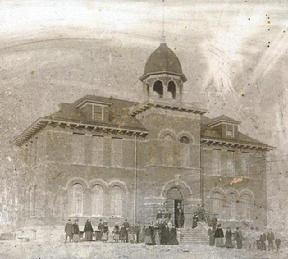
Central School alumni later purchased a massive, 380-pound solid-bronze bell from a foundry in Northfield, Michigan. It was installed in the school's cupola in 1914. More buildings were added to the site over the years. A high school opened at the western edge of the property in 1911, followed by a new gymnasium in 1919. The three-story brick Central School was the only one of the five buildings eventually constructed at the site to be demolished.
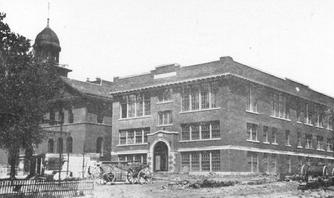
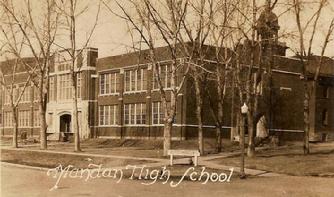
In 1934, high school classes moved into a larger building designed in the Tudor Gothic style then popular for educational buildings. That building now serves as the complex's main entrance. Architect Gilbert Horton, originally from St. Paul, Minnesota, relocated to Jamestown in 1911 and eventually designed 254 school buildings in North Dakota.
The new high school was constructed in front of Central School. The building on the eastern side of the complex was repurposed as the junior high school, while the additional space in Central School was assigned to the grade school.
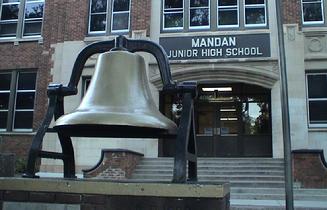
The bell remained in the Central School cupola until the building was demolished in 1958, after the current Mandan Senior High School was completed. The three-story brick building on the eastern side became a grade school after the 1934 building assumed its role as the junior high school. In June 1958, the bell was moved to a pedestal in the front plaza. When the complex was sold to a private investor in 2016, the bell was returned to the Mandan School District. It is now displayed at Mandan Middle School.
The school district sold the property to GPA LLC, led by Yegen Development, in 2012. After an attempted redevelopment was unsuccessful, Yegen donated the property to Spirit of Life Catholic Church. Commonwealth Development Corporation then undertook a project to convert the building into 39 affordable-housing units: eight three-bedroom, 28 two-bedroom, and three one-bedroom apartments. Amenities included a wellness center, chapel, community room, outdoor playground, green space, and off-street parking.
On August 2, 2017, the State Historical Society of North Dakota announced that the complex had been listed in the National Register of Historic Places. The complex, now called Historic Apartments on Fourth, opened as residential housing in December 2018.