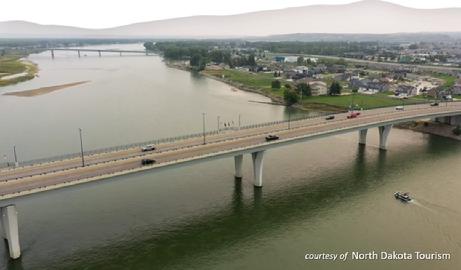
The current four-lane Liberty Memorial Bridge opened in 2008, replacing the two-lane bridge used since 1922. Mandan and Bismarck worked together to create a structure built around tradition, vision, and honor. The bridge honors all military veterans and everyone who has served or is serving in the United States armed forces.
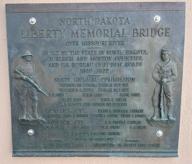
Plazas at each end incorporate 11 spires symbolizing the armistice that ended World War I at the 11th hour of the 11th day of the 11th month in 1918. Interpretive panels describe the bridges and their construction and operation. The original builder's plate from the 1922 bridge was installed in the west plaza to connect the new structure with its predecessor.
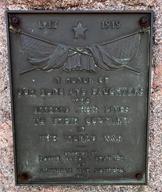
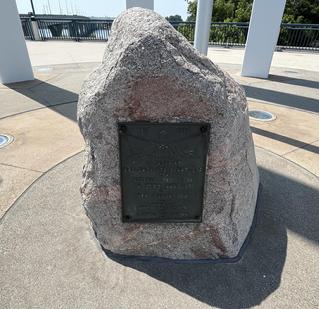
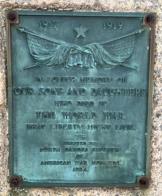
Two prairie-rock plinths and bronze plaques that stood at the ends of the former bridge were recovered and installed in the new plazas. The local chapter of the American War Mothers provided the plaques in 1924. They marked the bridge as part of a rural gravel route from Main and Hannifin streets in Bismarck, along Front Avenue, across the bridge, and down "the Strip" to the east end of Mandan's Main Street at present-day Mandan Avenue. Both cities designated that portion of U.S. Highway 10 as Memorial Highway, a name that remains in use.
Five overlooks along the south edge of the pedestrian walkway honor the Army, Marine Corps, Navy, Air Force, and Coast Guard with flags and service seals. Flags are raised at least five days each year: Memorial Day, Flag Day, Independence Day, Labor Day, and Veterans Day. Together, the flags, plazas, and south-side overlooks are intended to honor all veterans and symbolize service members standing guard and protecting their communities.
Work began in 2006 after studies determined that the previous bridge could not be upgraded to modern standards or accommodate traffic growth from approximately 2,000 to 15,000 vehicles per day. The steel-box bridge has 14 spans and six piers in the Missouri River. It extends 2,370 feet between its major abutments, is 84 feet 8 inches wide, and provides 28.5 feet of vertical clearance above the river. Its concrete contains coal fly ash and is reinforced with epoxy-coated steel to resist road salt.
The bridge, approaches, and associated road improvements cost $62 million. The North Dakota Department of Transportation owns the bridge, and Lunda Construction Company of Black River Falls, Wisconsin, was the general contractor.
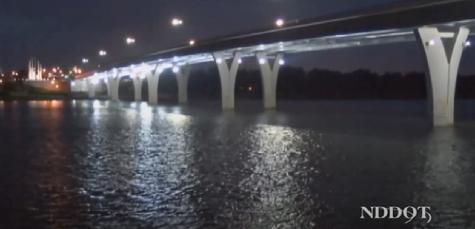
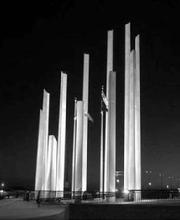
The end plazas, their spires, and the adjacent lower-level parks are illuminated at night. Lighting also marks the five pedestrian overlooks, their flagpoles, and the underside of the bridge.
The North Dakota Department of Transportation produced a video about the 1922 and 2008 Liberty Memorial bridges as part of the historical and cultural mitigation associated with removing the original bridge.