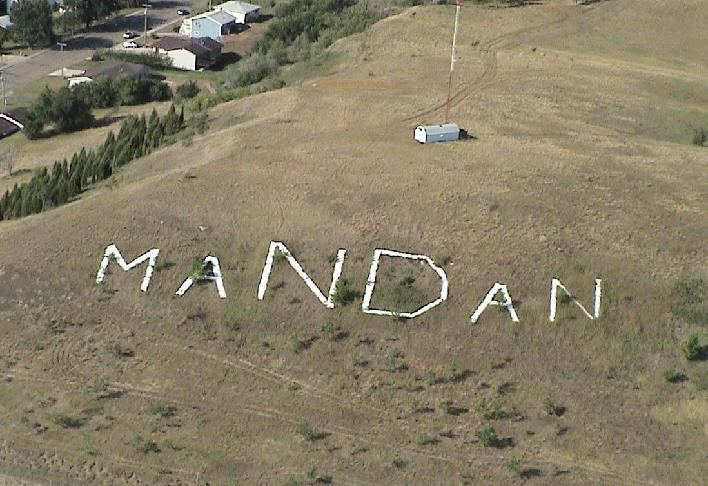
Mandan Hill, frequently called Crying Hill, has welcomed visitors and returning residents with its lettering for nearly a century. The landmark comprises three separate features: concrete letters spelling the city's name on the hill's northeastern face; the word "Mandan" spelled in trees on its southern face; and the hill itself, a sacred place of cultural importance to several Native nations.
The Mandan sign
During the 1920s, small towns across North Dakota and elsewhere placed their names on nearby hillsides. Signs remain at Bowman, Center, Kathryn, and New Salem. Before GPS and radio-navigation aids, the predecessor of the North Dakota Aeronautics Commission encouraged rural communities to mark their names on water towers and hillsides to help pilots identify their location during cross-country flights. Another explanation attributes the practice simply to civic pride.
The first Mandan sign was completed in 1929 by local Boy Scouts, who carried discarded paving blocks from the Sixth Avenue NW widening project to the hill. A nearby blacksmith shop provided whitewash. In 1932, Mandan Pioneer editor Edwin Tostevin proposed a larger, more substantial sign during a Mandan Lions Club meeting. After two years, civic leaders formally adopted the work as a community project.
The Mandan Boy Scouts led construction of a sign 300 feet long and 70 feet high on the southern face of Crying Hill in June 1934. Area businesses sponsored 47 truckloads of rocks collected from fields around the city. The Scouts used more than 12 gallons of white paint on the letters. The two middle characters—an uppercase N and D—were 85 feet high and represented North Dakota's official abbreviation. Local Boy and Girl Scouts maintained the sign for 30 years.
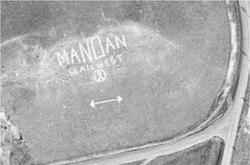
The sign was refurbished in June 1959. Missing stones were replaced, the letters were repainted, and railroad ties spelling "Trail West" were added to promote the new Custer drama opening at Fort Lincoln State Park that July. The Mandan Jaycees sponsored the work, with member Larry Sullivan serving as project chairman.
In August 1963, Mandan Jaycees spent 12 hours and eight gallons of paint rehabilitating the sign. A second line of white-painted railroad timbers promoted the Custer Drama at Fort Lincoln State Park. In August 1974, 26 members of Mandan's TOPS Club 17 (Take Off Pounds Sensibly), accompanied by several husbands, replaced missing rocks in both "MaNDan" and "MHS." The Chamber of Commerce provided white paint.
Construction of Interstate 94 north of the hill prompted the sign's relocation from the southern face to the eastern face in 1987, where it could be seen by approaching traffic. Large concrete panels replaced the loose stones to discourage vandalism. The marker has been described as North Dakota's largest sign.
As part of North Dakota's centennial celebration, Mandan planted a "Centennial Forest" in 1989 across the sign's original location on the southern face, with the trees also spelling "MANDAN." In September 2024, Doosan Bobcat employees cleared trees and brush around the concrete letters.

A plan to scrape and repaint the concrete panels in spring 2025 grew into a more extensive proposal because of their condition. The Three Affiliated Tribes owns the land beneath the letters M, A, N, and D, while the City of Mandan owns the land beneath the final A and N. The city approached the Tribes about jointly sponsoring the project, and both agreed that the lettering needed attention.
Residents, city staff, and community leaders developed a plan around the theme "Honoring the past. Healing the future," suggested by the Four Directions group at Mandan High School. The preferred concept measured 20 feet high and 130 feet wide and included LED illumination. Its estimated cost was $1.2 million, to be raised through private sponsorships.
Crying Hill
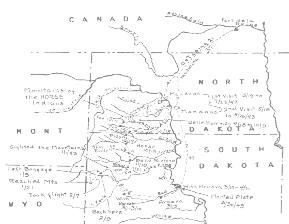
The sons of French explorer Pierre Gaultier de Varennes, sieur de La Vérendrye, were reportedly greeted in 1738 by Mandan chief Good Fur Blanket near the southern side of the hill. The hill's greater significance, however, comes from its importance to several Native nations. Mandan, Hidatsa, Lakota, Sioux, and Arikara traditions associate the place with sacred events and ceremonies.
As the highest point in the area, Crying Hill was sought as a place for prayer and solace. Pregnant women may have gone there to pray for healthy babies, while others undertook vision quests or sought guidance from departed loved ones. Native people of the region also used the area to mourn their dead.
Whether valued for its cultural significance or remembered as a childhood sledding hill, the place remains a historic Mandan landmark.