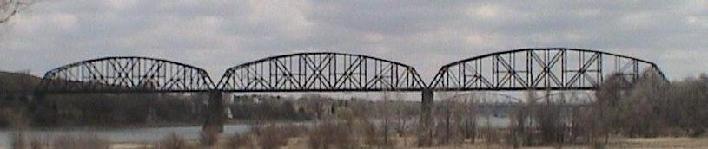
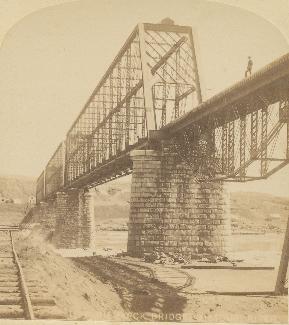
 Missouri River bridge superstructure">
The Northern Pacific Railroad announced in 1879 that it would extend its line 200 miles west to the Yellowstone River near present-day Glendive, Montana. Ferrying supplies across the Missouri River was an expensive temporary measure; a bridge across the "Big Muddy" was necessary to complete a northern transcontinental rail route.
The Missouri River narrowed north of Bismarck, and construction of a levee could narrow it further. Even so, three 400-foot spans were needed between land-supported approaches at each end. Announcement of the project brought thousands of workers to the area and helped determine the location of the work camp that became Mandan.
The name "High Bridge" refers to its 70-foot clearance above the river, intended to protect the structure from widely fluctuating water levels and the enormous sheets of ice common on the upper Missouri in early spring. Designer George S. Morison also placed metal sheaths, or blades, on the upstream sides of the piers to break apart the ice.
The bridge rests on piles driven into the sand and riverbed and on stone piers supporting the deck. Workers built the piers using timber-and-iron caissons measuring 74 by 25 by 17 feet. Each caisson was floated into position and sunk. Concrete poured above a false floor pushed it into the riverbed. Workers entered a hollow section at the bottom through an air lock and excavated beneath it until the caisson reached a firm layer. Granite piers were then built on the caisson foundations.
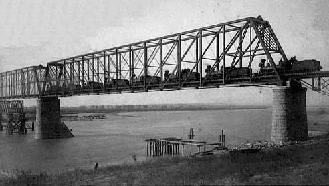
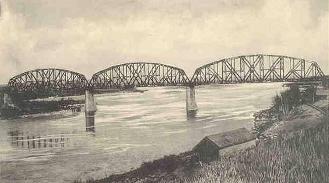
Work began on September 1, 1881. The east approach span was finished on May 9, 1882; the west approach on June 3; and the center span on October 18. The bridge cost $1,080,000 (about $36,031,000 in 2025 dollars). Between 200 and 600 men worked on the project at any given time, depending on the stage of construction.
The original spans had flat tops. They were replaced in 1905 after improved locomotives began carrying loads that exceeded the first design's capacity. Sturdier, arched trusses were erected on the existing piers and remained in service until September 2026 when traffic was switched to a new bridge built just upstream.